Doctor Who in an Exciting Adventure with the Daleks Novelization
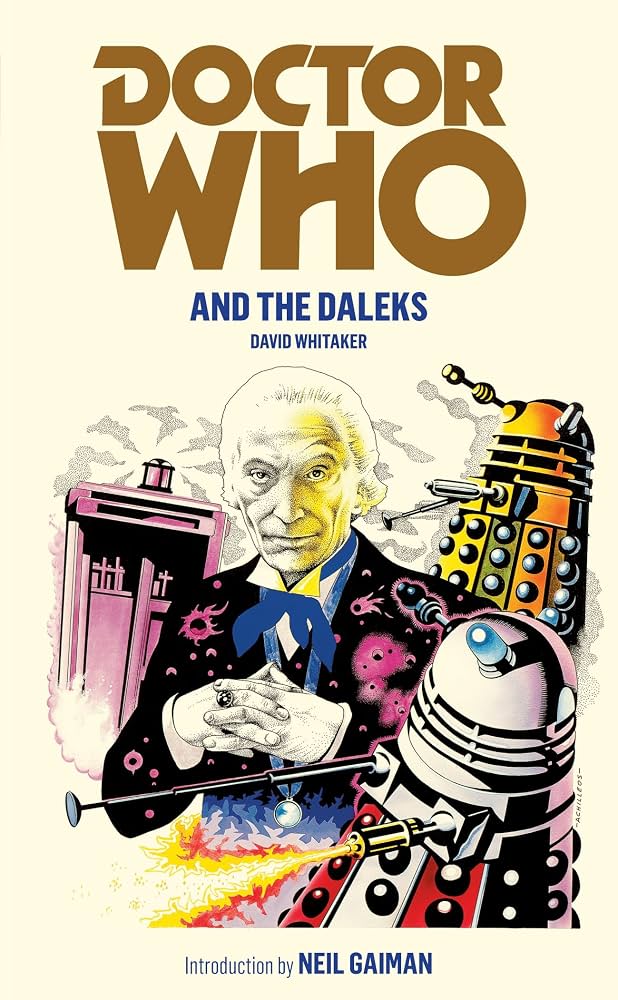
The Daleks novelization is an interesting artifact. It was published in November of 1964 by Frederick Muller Publishing. As such, it didn't have to follow the Target page limit. In fact, when Target published the book itself, it kept the story intact. That said, it's only 30 pages longer than Target's limit, and the first two chapters are spent introducing the characters and bringing them together for the first time, à la "An Unearthly Child".
But it gets more interesting. As it is the first novel published, one might expect it to present the origins of the four coming together, but Whitaker takes an entirely different approach. Coal Hill School plays no part in the story. Ian is a frustrated teacher trying to land employment at a research facility. Barbara, a secretary with a penchant for history, is hired by the Doctor to tutor Susan. They meet one night when Ian discovers Barbara stumbling along the road, trying to find help as the car carrying her and Susan gets in an accident. They encounter the Doctor and force their way into the TARDIS to phone the police for help.
The entire narrative is from Ian's point of view, which also makes for an interesting take as we learn that Ian quickly comes to grips with his situation, glad for the respite of the day-to-day life of trying to improve his situation after failed job interview after failed job interview. He keeps track of what the Doctor says and does, knowing that while the adventure is exciting, the Doctor is not someone he can trust. He is also just starting his relationship with Barbara, something that was already established in the TV show.
So why the different origin? Well, it goes back to something we're seeing now with "An Unearthly Child" and the refusal to allow it to be streamed online. The estate wouldn't allow it. Since this was the first Doctor Who novel released, there needed to be an origin for the casual reader unfamiliar with the show. Whitaker does a very good job of setting this up, with the cast sharing the same characteristics but approaching it from different circumstances, while still giving a nod to the actual television episode.
What's truly interesting, though, is that three chapters into this ten-chapter work, we have yet to see the Daleks. Indeed, at the end of chapter three, it is the following morning after discovering the fluid link emptied, and the crew is preparing to make their way to the city they discovered the day before. And because this is told from Ian's point of view, we do not get the famous scene with Barbara when the Daleks discover her. Instead, we are treated to Ian's narrative of how the other three were captured, and the Daleks' weapon knocked him out, his legs rendered useless. And when he comes to, we are filled in on much of the story through exposition by Susan.
The same thing happens as Susan is forced to travel to the TARDIS alone to retrieve the drugs she was given. Ian passes out again and awakens to find her standing over him; all four are doing better thanks to the retrieved drugs. Susan recounts the entire journey and how the Daleks forced her to write a note to the Thals, who extend their hand in friendship.
From there, the narrative pretty much follows the TV show's story. There is an interesting bit where Whitaker goes into more detail about what the Dalek looks like inside the casing, as we're getting Ian's point of view, and it only makes sense. But it does take away from that brief glimpse we get in the episode, which is far more effective as the viewer has to fill in the gaps rather than being painted the picture as Ian does. We also lose the scene where Ian is trapped in the Dalek as they make their escape up the elevator shaft. It's equally effective in both the TV show and the theatrical version.
An interesting characterization choice is to make the main female, Thal, Dyoni, Amazonian in features, whereas in the TV show, she was the same height as Susan. Whittaker gives her longer hair and stronger features, whereas in the TV show, she's just one of the girls who gets to speak.
The best part of the novelization is chapter seven, which features the scene where Ian convinces Alydon to defend themselves against the Daleks. It is quickly followed by a brief narrative of the groups organizing as they make their way to the Dalek city and the death of Alydon, which is dragged out for too long in the TV show. There is one nice touch as Ian and the others fight off a giant lake creature that is then devoured by more of its kind. Makes me wonder whether this was originally in the script and cut for budgetary reasons, or whether Whitaker added it so the journey wouldn't appear to have been cut too much.
Something else that is interesting about this work is that the word exterminate is used throughout the story by the Daleks. They never uttered it once on the TV show in their first story. They used variations of the word like extermination and exterminated, but it wasn't a war cry like we viewers have become accustomed to. Indeed, the word wouldn't be uttered the way we know it until "Dalek Invasion of Earth," which aired long after the publication of this tome. But Whitaker was the story editor for Doctor Who at the time, and he worked closely with Dalek creator Terry Nation on the Daleks comic for Century 21, so it's possible they already knew the Daleks would adopt this war cry, and he worked it into the novel.
We also get an appearance by a glass Dalek as Ian spots one that you can clearly see the creature inside. Why Whitaker didn't just wait until here then to give us the full description, rather than spoil it earlier in the work, I don't understand. The Doctor surmises, after the final battle, that the Dalek casing was not only to protect the Daleks from the atmosphere but also to power their hearts, suggesting they were even weaker than perceived.
I mentioned how Ian and Barbara meet for the first time at the start of this story, so some of the familiarity they had as co-workers at Coal Hill School is not here. Instead, we get highs and lows in their developing relationship, in particular when Ian yells at Barbara to escape with the Doctor and Susan while he warns the Thals of the trap the Daleks have set for them. Barbara is fiercely independent here and does not take well to taking orders from Ian. And like the knight in "The Wife of Bath's Tale" in The Canterbury Tales, Ian quickly learns and leaves the decision to remain with the Thals to Barbara when the Doctor proposes the idea to the two instead of the constant danger they may find themselves in by traveling with himself and Susan. They, of course, choose the danger.
This is an interesting artifact, as it tells the story we know as "The Daleks," the seven-part serial from 1963 and 1964, but there are several changes, and for the most part, they work. It is definitely worth a read and a key part of any Target collection, in my opinion.

An Unearthly Child Novelization


